The first round of retests comprised the first retests on Standards 8–16, from Quiz 2. Each standard had its own retest quiz on Canvas.
The criteria for satisfying the standards are explained in the table below. The first column gives the name of the quiz. The second column gives the total number of points available in the retest, and the last column tells the number of points needed to satisfy the standard.
| Quiz | Points | Cutoff |
|---|---|---|
| Standard 8 Retest 1 | 10 | 9 |
| Standard 9 Retest 1 | 1 | 1 |
| Standard 10 Retest 1 | 2 | 2 |
| Standard 11 Retest 1 | 1 | 1 |
| Standard 12 Retest 1 | 1 | 1 |
| Standard 13 Retest 1 | 4 | 4 |
| Standard 14 Retest 1 | 9 | 8 |
| Standard 15 Retest 1 | 3 | 3 |
| Standard 16 Retest 1 | 3 | 3 |
The first question, about the horizontal component of the initial velocity had two be hand graded. The answer key always held that the answer was zero, although in fact zero was never the correct answer. I overrode the Canvas-assigned scores by hand.
Question 3, a select-all question, also required hand grading. I treat this question as six true/false questions.
This quiz had one question, as a physics problem you did in the launcher lab. From the horizontal range and launch height, you can find the launch speed. Then with the launch speed known, you can find the horizontal range resulting from any launch angle.
Question 2 was a “select all” question, needing hand checking. The only correct answer was “To change a body's velocity.”
Going through the cloud, the net force on the spacecraft is zero, so its velocity stays constant.
All you need to know to find the net force are the mass and acceleration.
I needed to hand-check the answers in case a student misspelled a word or used a synonym. The most common mistake students made in answering these questions was to name a force rather than the object exerting the force.
All three questions were supposed to be three points, but Question 2 was mistakenly set to only one point. I changed it to three points after the quizzes were taken. Your quiz may still show one point for question 2. But all the questions were graded as out of 3, and the quiz should show nine total points.
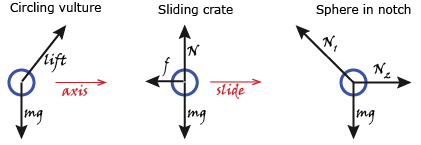
The circling vulture’s free body diagram was a little tricky, because we haven’t addressed forces from the air. The key idea here, however, was that the vulture is accelerating inward toward the center of its circle, but is not accelerating vertically. Although it is rising, it is rising at a constant rate. So the free body diagram ought to show the downward weight, some sort of upward force to cancel the weight, and some sort of inward force to create circling.
The crate sliding on a level floor experiences an uprward normal force and backwards friction from the floor in addition to its weight. Friction is opposite the direction of its velocity. If nobody is pushing the crate (sliding to a stop), there is no force in the direction of its velocity.
The sphere stuck in the notch experiences its weight and two normal forces: one from each of the rock faces of the notch. These normal forces are perpendicular to the rock faces, outward from the faces (inward on the sphere). The net force is zero both vertically ands horizontally.
The most common mistakes in the free body diagrams were drawing forces in the wrong direction, not including forces that were present, and including forces that are not present. A good question to keep in mind when making a free body diagram is “what objects is this interacting with?”
Copyright © 23 October 2024.
Revised: 27 October 2026. Maintained by Richard Barrans.
URL: http://www.barransclass.com/phys1110/Exams/P1110_F26_R2_crit.html